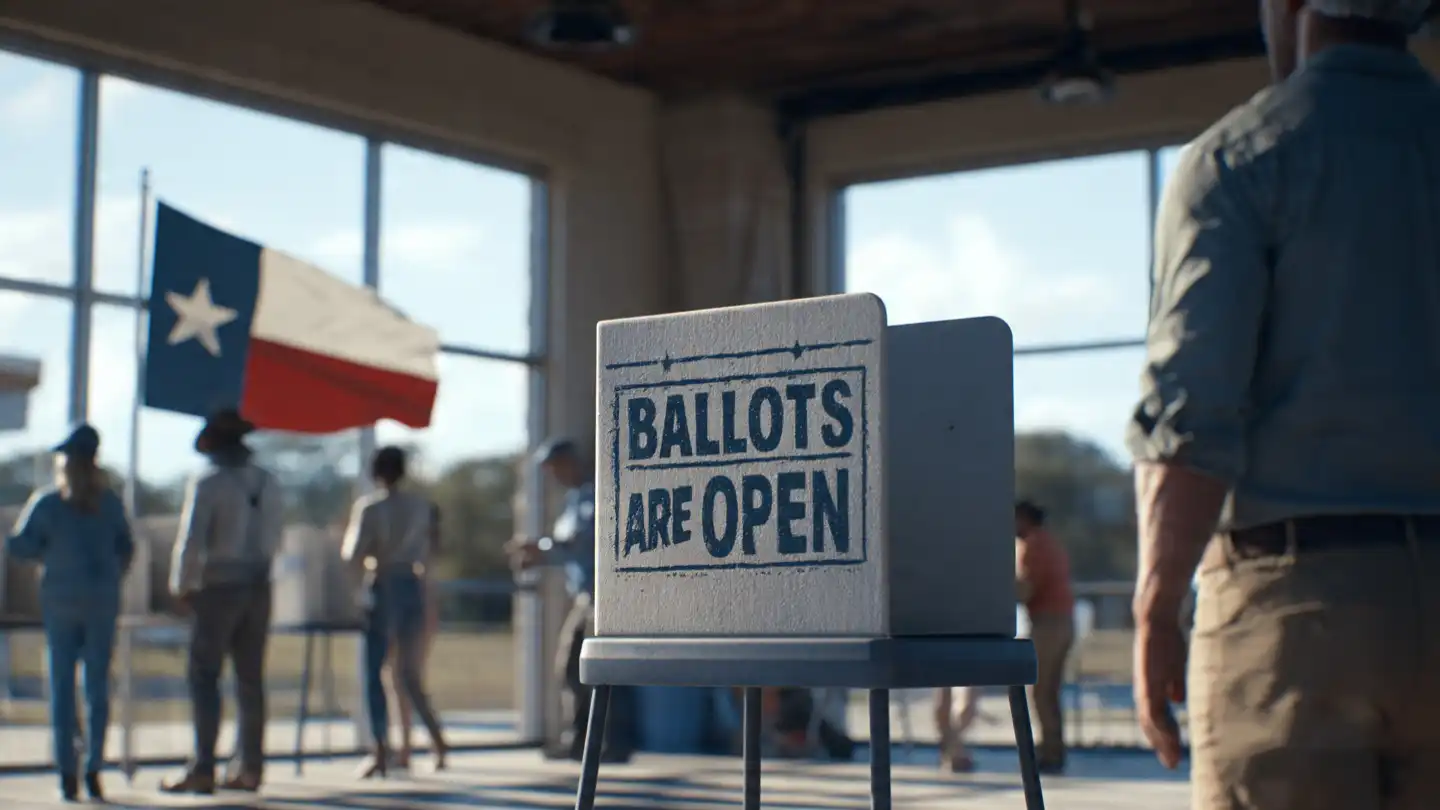
Early voting is underway in the 2026 Primary Runoff Election, with a bitter Republican Senate showdown and contested Democratic primaries setting the tone for a pivotal fall campaign season.
Polling locations across Texas opened their doors Monday for the start of early voting in the 2026 Primary Runoff Election — and in a state with nearly 19 million registered voters, the path to the November ballot runs directly through these next few days of early balloting.

For Austin residents, the runoffs carry weight at every level of government. But it’s the Republican battle for the U.S. Senate nomination that has sucked most of the political oxygen out of the room — a bare-knuckle contest between longtime incumbent Senator John Cornyn and former Texas Attorney General Ken Paxton.
| ~19M | <5M | 14M+ |
| Registered Texas voters | Voted in the March primary | Eligible uncommitted voters |
The GOP Senate Fight: Cornyn vs. Paxton
Senator Cornyn kicked off early voting day at a South Austin polling location with his wife by his side. Afterward, he made no effort to soften his rhetoric toward his challenger, questioning whether Paxton — who built his career in Texas state politics — is equipped to be effective on the national stage.
“Ken Paxton is going to be lost in Washington, D.C. It’s going to take him a couple of years to figure out where all the restrooms are in the nation’s capital.”— Sen. John Cornyn, speaking to reporters in South Austin.
Paxton, meanwhile, held a “Get Out the Vote” rally in Dallas, where he framed his record against Cornyn’s decades in office. He argued that his work as Attorney General — including high-profile legal battles against the Biden administration — far outstrips Cornyn’s legislative output over a long Senate career.
“I’ve accomplished more in any two weeks — John can pick it — than he’s accomplished in 42 years.”— Ken Paxton, at a Dallas “Get Out the Vote” rally.
A new poll from Texas Southern University adds a wrinkle to the Republican infighting. Both Cornyn and Paxton are essentially tied in hypothetical general election matchups against Democratic nominee James Talarico. This finding will likely fuel Democratic enthusiasm heading into the fall.
Talarico Targets Both Republicans
Talarico, who recently received an informal endorsement from former President Barack Obama during a campaign stop in Austin, wasted no time framing the runoff in terms that benefit his general election positioning. In a statement issued on the first day of early voting, he cast both Republican candidates as part of the same establishment machine.
The Democratic nominee said that regardless of who emerges from Tuesday’s Republican runoff, his campaign is focused on the same opposition: big-money donors and what he called a “corrupt political system” that prioritizes wealth over working Texans. It’s a message clearly designed to consolidate the Bernie Sanders-leaning Democratic base while appealing to frustrated independents.
Cornyn, for his part, attempted to dismiss the TSU poll while simultaneously warning that Talarico presents a genuine ideological challenge — comparing him unfavorably to the Vermont senator. Paxton, meanwhile, continued to brush off concerns from party insiders who worry he could be a down-ballot drag for Republicans in competitive races.
Down-Ballot Battles: Democrats Fight Among Themselves
Republicans aren’t the only ones with internal scores to settle. On the Democratic side, the runoffs feature some genuinely competitive, at times contentious, contests.
The fight for the Democratic nomination for Lieutenant Governor pits Austin State Representative Vikki Goodwin against Houston labor organizer Marcos Velez — a matchup that reflects the broader tension between the party’s suburban professional wing and its labor-left base. Turnout among Travis County voters could prove decisive in that race.
The attorney general’s race has turned nastier. Joe Jaworski and Nathan Johnson are engaged in what insiders describe as a sharp-elbowed contest that has grown increasingly personal in its final days. Both are banking on the same theory of the election: that widespread voter discontent with Republican governance gives Democrats a genuine opening this fall.
Democratic Runoff Races to Watch
- Lt. Governor: Rep. Vikki Goodwin (Austin) vs. Marcos Velez (Houston labor organizer)
- Attorney General: Joe Jaworski vs. Nathan Johnson — a contentious, closely-watched primary fight
- Governor: Gina Hinojosa is the Democratic nominee, already through to the general election
Abbott Stays Neutral — and So Does His Ballot
Governor Greg Abbott voted early at a Central Austin location but declined to offer a late endorsement in either the Senate race or the Republican attorney general runoff. Citing the sanctity of the secret ballot, he sidestepped repeated questions about his preferences — a notably cautious posture for a governor who usually has no shortage of strong opinions.
Abbott did, however, preview his general election strategy: drawing sharp ideological contrasts between Republican and Democratic nominees. He expressed confidence that once the runoffs are settled and the fall campaign begins in earnest, Republican voters will consolidate behind their nominees. Democratic gubernatorial candidate Gina Hinojosa fired back, arguing that Abbott and his donors have left Texas families struggling with an affordability crisis.
Who Gets to Vote — and Why It Matters
Here’s a critical piece of Texas election law that every Austin-area voter should understand: if you voted in the March primary, you are locked into your party’s runoff. Republican primary voters must vote in the Republican runoff; Democratic primary voters must vote in the Democratic runoff.
But if you sat out March entirely? You’re what election analysts call an uncommitted voter — and you can choose either party’s runoff ballot. With fewer than five million Texans casting ballots in March, that leaves a massive pool of potential voters who could tip the scales in closely contested races.
Austin Voter Quick Guide
- Voted in the March primary? You must vote in the same party’s runoff
- Didn’t vote in March? You’re uncommitted — you can vote in either party’s runoff
- Nearly 14 million registered Texans did not vote in March, making them potential runoff wildcards
- Check the Travis County Clerk’s website for your nearest early voting location and hours
- Runoff Election Day: Tuesday, May 26, 2026
What Austin Should Watch For
For a city that leans heavily Democratic but sits inside a state still dominated by Republicans at the statewide level, the runoffs present a fork in the road. On the GOP side, the question is whether Austin-area Republican voters break toward Cornyn’s institutionalist pitch or Paxton’s populist, Trump-aligned energy.
On the Democratic side, the Austin metro’s outsized role in both the Lt. Governor and attorney general runoffs means that local turnout could determine which direction the party heads into the general election — moderate and coalition-building, or energized and confrontational.
Either way, the Texas political map is shifting beneath everyone’s feet. Obama’s Austin appearance was no accident; Democrats sense an opportunity in a state that has been trending toward competitiveness for years. Whether that opportunity cracks open or slams shut may depend on what happens in the next several days of early voting.
 Best Hiking Trails in Austin 2026 – Scenic Trails, Waterfalls & Hikes
 Top Thrift Stores in Austin for Vintage, Retro & Budget Shopping
 Top Italian Restaurants in Austin for Pasta, Pizza & Date Nights
 Best Lunch Spots in Austin 2026 – Healthy, Hearty & Delicious
 Dirty Sixth Street Austin – Best Bars, Restaurants & Map 2026
 Best North Austin Happy Hours: Top 10 Deals for 2026
 Best Downtown Austin Happy Hours: Top 12 Food & Drinks’ Deals
 Best Mocha in Austin 2026: Matcha Lattes, Desserts & Coffee Bars
 Best Desserts in Austin 2026 – Top Bakeries, Bars & Sweet Treats
 Best Happy Hours in Austin – Downtown, North Austin & Weekday Specials
 Best South Austin Happy Hours for Great Food and Drinks
 Best Lakes in Austin for Relaxation and Outdoor Recreation
 Best Happy Hours Austin: Top Spots for Drinks & Bites
 East 6th Street Austin TX: Complete Entertainment District Guide
 Halloween on 6th Street Austin: Ultimate Halloween Party Guide
 Austin Arbor Food Park Menu | Best Food Trucks & Local Eats
 6th Street Austin Guide 2025: Best Bars, Music & Things to Do
 Thicket Food Park: South Austin’s Hidden Community Gem You Need to Discover
 Arbor Food Truck Park: Guide to East Austin’s Best Food Trucks
 Hotels Near 6th Street Austin: Best Downtown Accommodations 2025